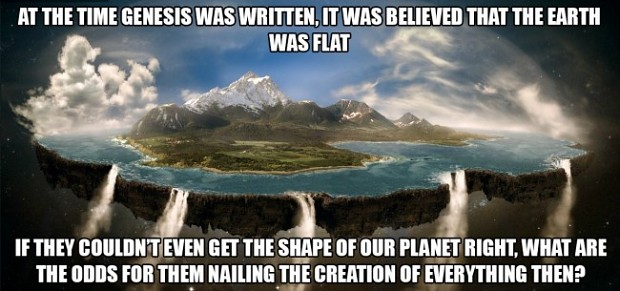
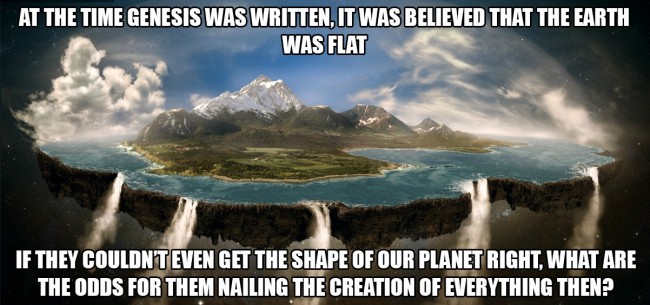
I don't think you understand where the idea of the Earth being flat comes from
Neither does this dismiss the idea that they knew of the creation. That is generalization. And also you are presuming because the largest body believed this, everyone had to. That is logically flawed.
The Earth being flat was a theory proposed by Ptolemy that was adapted by the catholic church. Not by the early Isrealites of those times in Genesis.
The belief that all ancient societies believed the earth was flat is itself a myth. Still, the bible refers to the earth as having "four-corners" and the sky as a "firmament", which certainly seems to imply the earth was believed to be flat and the sky a solid object. In many of such verses there is no indication they are not to be taken literally (some yes), in genesis for instance it basically says "God created the earth" in one verse and in the next says "he created a great firmament" (thats definitely not exactly what it says). I see no reason to not take that literally, and the author seems to be meaning for it to be taken literally. You can shoe-horn many parts of the bible to fit with your beliefs, but you will still run into problems.
sure. And the beasts of revelation are literal too. Ooooh lets throw out contextualisation in the incinerator and read it like a children's book. Lets burn the external research made by scholars who have studied the text and read the actual hebrew because xxT65xx says that archaic english is identical to the orginal language it was written in.
give me a freaking break.
I'm not saying that, not about Revelation. You see, contextually it does not make sense to presume in many cases that the author intended a specific verse to be taken allegorically. I'm not talking about poetry or prophecy, although even then it's sketchy. I was thinking mostly of Genesis where (like I said) in one verse it says "God created earth" and the next says "God created a great fermament" (the sky). Some of the more recent translations seem to kind of paraphrase verses like that to mean exactly what the guy translating it thought it meant, rather than accurately giving a hebrew-english translation. Although you can take the verse to mean whatever you want, that doesn't seem to be what the author intended the verse to mean in the original language.
False. The Bible does not say the earth is flat nor did God's followers believe it to be so. Even in the original Hebrew it says the earth is a circle (or sphere).
Valid point :P
Next thing you know is that the creatonists start claiming that earth is flat.
Unfortunately, they exist. Look up flat-earther, and you'll probably find some, though they're not nearly as popular as they used to be.
hmmmm
I don't think you understand where the idea of the Earth being flat comes from
Neither does this dismiss the idea that they knew of the creation. That is generalization. And also you are presuming because the largest body believed this, everyone had to. That is logically flawed.
The Earth being flat was a theory proposed by Ptolemy that was adapted by the catholic church. Not by the early Isrealites of those times in Genesis.
The belief that all ancient societies believed the earth was flat is itself a myth. Still, the bible refers to the earth as having "four-corners" and the sky as a "firmament", which certainly seems to imply the earth was believed to be flat and the sky a solid object. In many of such verses there is no indication they are not to be taken literally (some yes), in genesis for instance it basically says "God created the earth" in one verse and in the next says "he created a great firmament" (thats definitely not exactly what it says). I see no reason to not take that literally, and the author seems to be meaning for it to be taken literally. You can shoe-horn many parts of the bible to fit with your beliefs, but you will still run into problems.
sure. And the beasts of revelation are literal too. Ooooh lets throw out contextualisation in the incinerator and read it like a children's book. Lets burn the external research made by scholars who have studied the text and read the actual hebrew because xxT65xx says that archaic english is identical to the orginal language it was written in.
give me a freaking break.
I'm not saying that, not about Revelation. You see, contextually it does not make sense to presume in many cases that the author intended a specific verse to be taken allegorically. I'm not talking about poetry or prophecy, although even then it's sketchy. I was thinking mostly of Genesis where (like I said) in one verse it says "God created earth" and the next says "God created a great fermament" (the sky). Some of the more recent translations seem to kind of paraphrase verses like that to mean exactly what the guy translating it thought it meant, rather than accurately giving a hebrew-english translation. Although you can take the verse to mean whatever you want, that doesn't seem to be what the author intended the verse to mean in the original language.
wait... are you trying to tell me the earth isnt flat?
False. The Bible does not say the earth is flat nor did God's followers believe it to be so. Even in the original Hebrew it says the earth is a circle (or sphere).
WRONG WRONG I'M RIGHT!
(I'm using creationist debate tactics)
NO, you aren't. I followed up with a reason. You just simply spouted something without a reason.
"Even in the original Hebrew it says the earth is a circle (or sphere). "
O rly? Care to explain? I would disagree.